
TaijiQuan
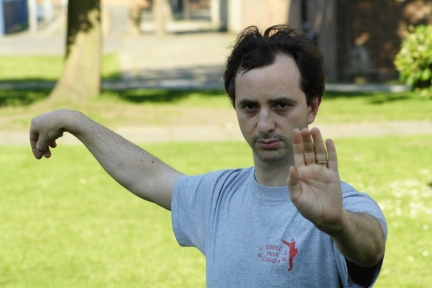
Taijiquan can be translated as "Grand Ultimate Fist", or interpreted as "Fist of the Mind". YMAA focuses mainly on traditional Yang Style Taijiquan. The form that is practised in YMAA schools originated from Yang, Ban-Hou. This form emphasises whole body movement.
Practitioners of Taiji develop:
- A calm, focussed mind
- Improved mind-body co-ordination
- Enhanced strength, suppleness and balance
- Improved overall health and energy
- A relaxed, centred and de-stressed attitude.
- A greater awareness of the interplay of the mind, body, breath and spirit.
Taiji training at YMAA London is carefully structured to allow the Taiji exponent to develop in stages. Students start off by learning the Yang style long form. The sequence is that part of Taiji which the public are most familiar with. However few get to understand the rich benefits that can be had from practising it. The sequence trains the mind, body and spirit in the fundamental principles of Taiji and is both relaxing and invigorating. The Taiji sequence also expresses the martial techniques of Taijiquan, one of the most effective and efficient martial arts; hence students will be familiarised with the short-range defence strategies contained within the sequence. There is also the opportunity to learn weapons sequences, i.e. Taiji sword and sabre.
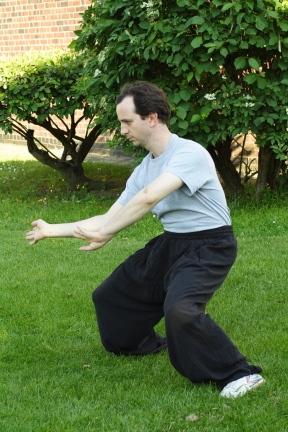
Students are also introduced to Taiji pushing hands. The purpose of pushing hands training is to allow students to practise together to develop deep feeling and sensitivity to allow effective expression of Taiji martial techniques. Taijiquan emphasizes sensitivity to touch, understanding, following, sticking and adhering. Pushing Hands trains the fundamental martial energy patterns of Taiji. These include wardoff (Peng,), rollback (Lu), press or squeeze (Ji), push (An), pluck (Cai), rend or split (Lie), elbow (Zhou), and bump (Kao). In addition, other advanced techniques such as coiling, controlling, borrowing, leading, and neutralizing are trained. There are four single and six double pushing hands techniques for stationary pushing hands training. Students will then move on to moving pushing hands, incorporating footwork.
Taiji QiGong is incorporated into classes. These include a range of different QiGong sets providing health and martial benefits. Dr. Yang was the first Taiji Master to expose Taiji Ball training to the west. This is extremely beneficial training for body, mind and energy; and improves the student's expression of Taiji principles in the sequence and in application. Silk Reeling Taiji Symbol training based on the Yin, Yang Taiji symbol is also taught. Both Taiji Ball and Yin/Yang symbol incorporate static, rocking and moving patterns.
YMAA London also teaches the extremely rare Taiji Fighting Set. This Taiji sequence was designed so that two people could practice together in a situation resembling actual fighting. The fighting set teaches, stepping, angling, fighting distances and the application of correct fighting technique. This practise helps Pushing Hands and Silk Reeling come alive and deepens overall understanding of Taiji. The aim of this sequence is to bring the components of the YMAA Taiji syllabus mentioned above together and to lead the student into free sparring using Taiji principles.